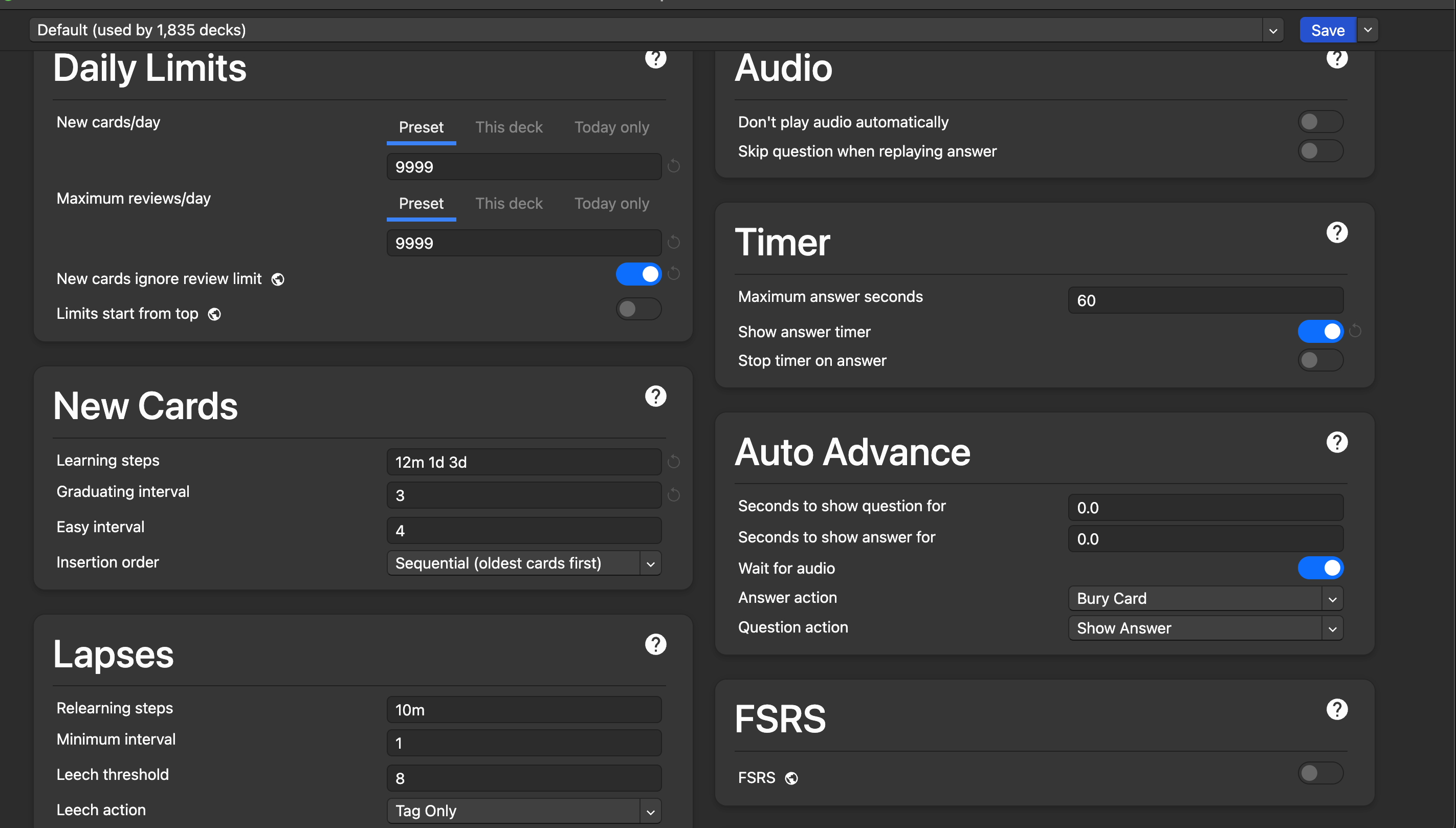
My daily review count is in the 600s/700s every day wheras my peers who are adding the same amount of cards on a daily basis have much less (300 max). Is it because I don’t have FSRS turned on, my correct answers on mature cards is too low (71.7% - compared to 80% for my peers) or a different reason? The only difference I see between my settings and my peer’s is that they have FSRS turned on, but when I turn mine on it messes up my intervals so I turned it back off.
I have attached my Stats and settings for the deck in question. Would truly appreciate any help!
Could be. FSRS generally gives longer intervals, which means lower workload.
Could be. Your retention is lower, so your cards are staying at shorter intervals, which means higher workload.
It also could be related to the specific modifications you’ve made to the SM-2 defaults – like extra learning steps, a graduating interval that isn’t longer than you last learning step, or any other changes that are outside of your screenshot.
Even if you see different intervals with FSRS than with SM-2 – that doesn’t necessarily mean they are wrong.
Thank you for the responses! When I turned on FSRS, a card that stated “10 days” for Good would change to “3 days” and over 2-3 days my Reviews spiked a lot even though I added new cards as I think FSRS was resetting all the intervals. But since I am starting my dedicated period for step 1 in a little more than I month I did not see the purpose in turning it on now if it is increasing my workload so much.
I did my best to follow the instructions for FSRS but it is hard because my deck has been for months in the default Anki settings. If my intervals are 12m 1d 3d you are saying my graduating interval should be higher than 3 days?
Also regarding FSRS - I am not sure if it is an unavoidable problem that the intervals all shorten when it is turned on, or if it is a mistake on my end.
Yep. If you’ve already remembered the card after a 3d step in Learn, then it doesn’t make sense to set it for a 3d interval again when it graduates to Review.
Looking at your Stats, I’d say it’s possibly unavoidable, but it’s not necessarily a problem. When you enabled FSRS, what did you set for your Desired Retention (DR)? If you left it at 90%, that’s most likely why your workload increased.
Your Stats don’t show the Retention table (maybe you’re using an older version of Anki?), but I can see from your Answer Button graph that your retention is quite low. If you tell FSRS your goal is to get to 90% retention, it will schedule your cards to get you there. And increasing your retention that much will be a LOT more work.
But with FSRS, you control that lever. If you want scheduling that will push you up to 90% retention – you can have it. [That’s what I mean by it not necessarily being a problem.] If you don’t – then don’t set your DR so high.
Regardless of where you set it, make sure that when you get a card wrong, you’re doing whatever is necessary to give yourself a better chance of getting it right the next time you see it. If you just click Again and hope for the best, you’re skipping the step where the learning happens.
The other red-flag I see is your max interval. That’s too low. The purpose of spaced repetition is that your easier cards get longer and longer intervals and get out of your way, so you can focus on your more challenging cards. This interferes with that. If you can’t handle the default of 100y (36500d), most folks are happy with something in the 3-5y range (1000-2000d), but anything under 1y (365d) is probably going to hurt.