I have been currently working through my Anking deck which currently has 17k reviewed cards, which is an old deck (first review around 2020). My Desired Retention for this deck is around 85%. I have done around 250k reviews this year, with around 650 cards done every day and with a true retention of around 83.5%. However, my reviews don’t seem to be going down at all: my daily load is around 1,040 and I now have a huge backlog, even if I have around 12k cards matured out of 17000.
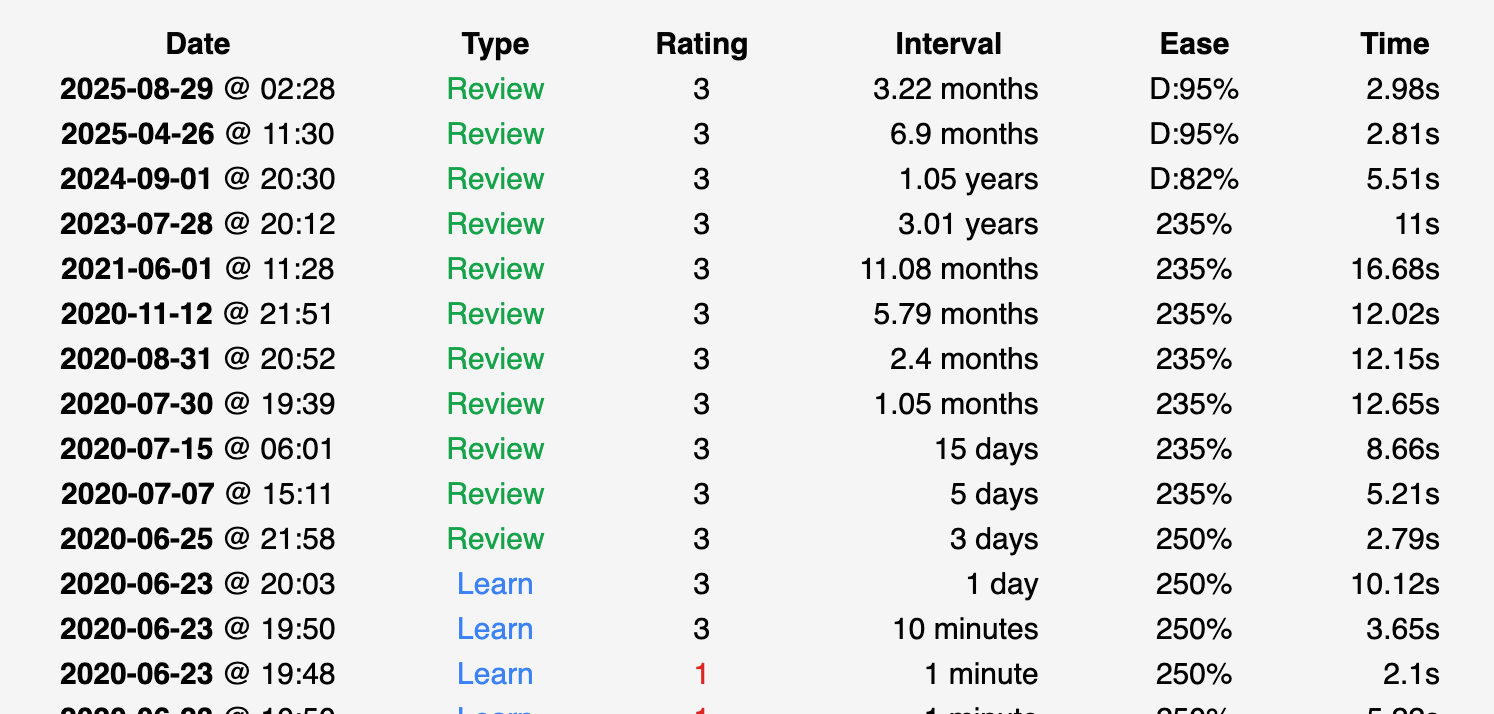
I’m thinking this is due to my high difficulty, which is 87% for the entire deck. The culprits almost are cards that I have done before FSRS, often those done in 2020 or 2021. There are a bunch of cards like this for example, which have a high difficulty despite not missing a single review.
Is there something wrong with my algorithm? I don’t remember if I did something in the past to make it mess up. Here are my current parameters: I have tried ignoring reviews up to a certain date, but it doesn’t seem to help much: 0.6176, 0.6176, 2.1916, 6.4465, 7.4667, 0.2477, 1.8721, 0.0094, 1.2165, 0.3234, 0.6151, 1.3935, 0.0818, 0.4439, 0.7555, 0.4094, 2.0978, 0.8718, 0.0000, 0.2113, 0.1004
Your true retention is close to your desired one. So, it seems that FSRS must show you these many reviews in order for you to achieve your desired retention. If you feel that the review load is high, you may want to decrease your desired retention or decrease the number of new cards per day (if you are still doing new cards).
I understand what you’re saying, but I’m not sure if having desired retention match true retention is the only way to determine the viability of the algorithm: as I showed before, there are some cards that are clearly not having at least some parameters calculated right (in this case, difficulty being 95% when I never got the card wrong doesn’t seem to make a lot of sense).
You seem to be implying that some of your cards are being shown more frequently than necessary (causing a high review load), even though the average value of true retention is not affected much. That’s possible and an easy way to test it would be to add prop:d>0.8 to the search query at the top of the Stats page and see if the true retention of these high difficulty cards is unreasonably high.
I am having the same issue with one of my older decks. I keep getting regressive intervals (i.e., intervals that are much shorter compared to the previous intervals, and also compared to the time elapsed since the last review) for cards I know well.
The following are a few examples. At the top you can see the review history, and at the bottom the intervals calculated by FSRS-6, at 90% desired retention.
My current solution is to let FSRS calculate the appropriate parameters, and then manually edit the eighth parameter (difficulty multiplier). I know it is not advisable to manually edit parameters, but this is a huge deck with a huge backlog, so I am willing to take some risk. (For now, this approach seems to work well enough, though I have only been using it for a few weeks).
I feel a little hesitant because in the manual, it does strongly advise against changing the parameters. What difficulty parameter have you found success with?
Do you mean “retention of these cards”? If yes, it implies that FSRS is working exactly as it should. But if you want lesser reviews, you may want to decrease your desired retention.
But shouldn’t these cards have less average retention over the year than my less difficult cards, providing that’s the reason why they are difficult in the first place?
FSRS tries to schedule cards so that their probability of recall when they are due is equal to your desired retention. So, if that’s showing up in the data, it means FSRS did its job well.
Your initial D values are really closely clustered – from 60% for initial Easy to 72% for initial Again. But that doesn’t necessarily mean something is wrong – it means that your cards don’t vary much from each other in objective difficulty.
[Sorry, this is the best screenshot I could get from Anki FSRS Visualizer – but you can plug in your parameters and click the “Difficulty” radio button to see this there.]
I strongly recommend that you do not manipulate your parameters yourself. D isn’t a value that you need to try to improve. It’s a value that FSRS uses schedule your cards more accurately.
You’re not reaching your DR (Desired Retention), so there doesn’t seem to be anything objectively wrong with your workload staying high – from an “is FSRS scheduling my cards correctly?” perspective. Obviously there are still good reasons your want a lower workload – but that doesn’t mean FSRS is doing something to prevent your workload from going down.
It looks like this material is challenging for you. It also looks like you don’t use Hard at all – are you a 2-button grader?
That does put you at somewhat of a disadvantage, because you’re not giving FSRS as broad a scope of data as you could. I’m not suggesting you necessarily switch to 4-button grading – it has its own downsides, and especially after years of use, that would be a hard habit for you to change. But it’s something to understand about why FSRS treats your cards as more the alike than different.
Is that your overall retention for the year? Even if it’s really that close to your DR, it might be worth bringing your DR down to 84% to give yourself a bit of breathing room.
A constant backlog is undesirable for a bunch of reasons. Trying to just “chip away” at your overdue cards often doesn’t work, because the cards you work hard to revive can get lost, and you end up needing to relearn the same cards again and again. If you aren’t already, you might want to try a plan that prioritizes keeping up with your “current” cards, and allows you to work on catching-up gradually – Adressing Backlog - #2 by Danika_Dakika.
Thanks a lot for the detailed response! I’ll try testing out a few things: yes, I am not using Hard very often if at all, so I will try using that, or bringing down my retention a tad bit (for some odd reason, the backlog is still very high, but a bit normal).
It just seems a bit odd that difficulty is so high for a good amount of cards that I find absurdly easy, often in the 97-98% mark. My difficulty for my whole deck is around 95% even, and it doesn’t seem nearly that hard; as I said, there are some cards that are ranked very difficult and that I’ve gotten right every time. I guess, as well, I should be using Easy on these? Thanks for your help again
Since you have little-to-no review history for 2 of your grading buttons, if you are considering switching to 4-button grading, you should step very carefully. There’s no guidebook for switching to a different grading habit, so you’ll want to consider racking up a good amount of countable reviews for those buttons before you optimize, and keep an eye on how your parameters change.
As far as learning to grade with all 4 buttons – consistency is key. Studying - Anki Manual
FSRS tries to aschedule all cards at the same level of retention. So if your difficult cards have the same retention as your easy cards, that’s a feature, not a bug.
(I didn’t actually understand from your responses whether your high D cards have the same retention as low D cards, but if they do, that’s intended)


 – but that doesn’t mean FSRS is doing something to prevent your workload from going down.