So thanks to advice I had received here I made a series of changes to how I anki’d. That thread is here. But to summarize it, I fiddled with my learning and relearning steps, going from 10m to 40m to 3 hours. I also realized I had been using Easy as a default button instead of Good, so I am starting to use the latter as my main button. That’s all well and good. I mentioned in the thread that the switch to Good from Easy was causing a review spike, but even then that’s to be expected.
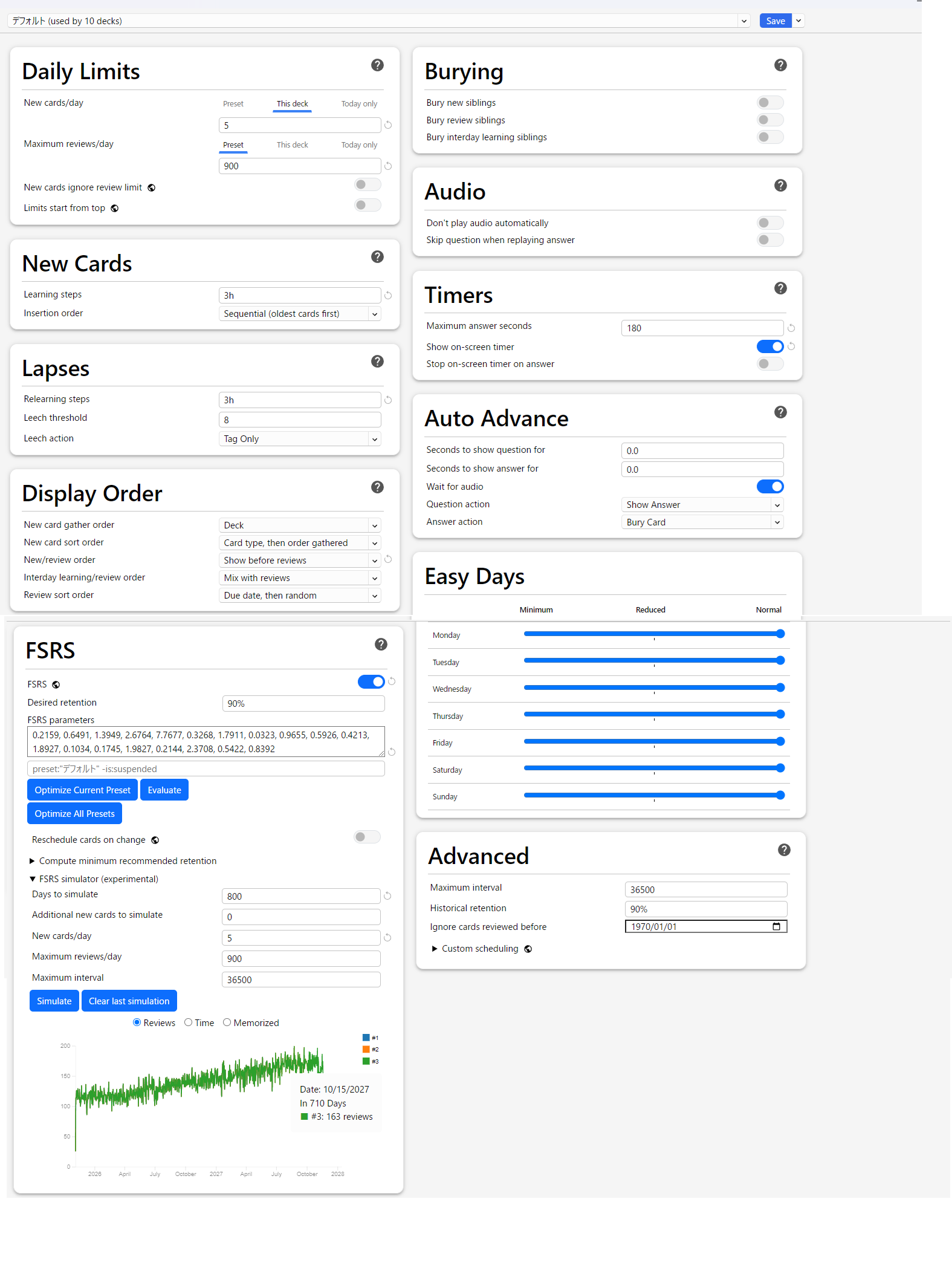
The reason I am making this new thread is because upon running the built in FSRS simulator on one of the two decks I actually use, I found this waiting for me.
For a second I thought “oh, this is just counting how many reviews that I’ll have if I don’t do anything for the next three hundred and sixty five days”. But of course,
If the number goes down at some point, that can’t be the case. Furthermore, on a separate deck, although it does spike, it only goes up to two hundred or so. Note that this deck has five new cards a day as opposed to three.
For more background, The first deck is a kanji handwriting deck from (常用漢字書き取り [Jouyou Kanji Writing Practice] - AnkiWeb) and the second is a deck I made myself by making a chart of every new Japanese word I encountered in “the wild” and then choosing five of them every day to make into a card. The first is significantly more difficult than the second. I only do Anki once a day, at nighttime. The template names are in Japanese, so for the record, the image on the left is the writing one and the one on the right is the other. The right image mentions it is used by ten decks, but only the Japanese vocab one sees any use.
Is whatever the hell is going on here reversible? Obviously if I start using “Good” more often than “Easy”, the algorithm will assume I’ve just gotten dumber, but at some point wouldn’t it adjust? Is it in the process of adjusting and I’m just getting ahead of myself?
Any response would be appreciated, and I would hope I’m not committing some sort of faux paus by asking so many questions so quickly.
Attached is the full stats page of both the decks in question
Unfortunately, I am not meeting my target retention just yet (frankly me ever doing so is unclear). Kanji writing is extremely complex, and relies a lot on muscle memory. With the learning step changes I made whenever I get a new card I will first go over it outside of anki (since I don’t have to get it right once a session) . If I didn’t do that I would have a deck exclusively of leeches.
Putting that aside, my retention has never been perfect to begin with (far from it, lol, my retention has always been mediocre) , but the handwriting deck was fairly stable until I started making changes like I was. Even on days after I got things wrong in succession it was never spiking to this extent.
I understand that naturally, when starting to make good my default it will cause large swells in reviews. There’s been like an increase by like a hundred extra reviews so far, and I’m comfortable. but surely that swell wouldn’t last over a year and up to six hundred reviews, right? Also, if it was just that then my other deck would be like this too, right? Am I just being paranoid, and with a little bit more time slowly getting the hang of grading again (I think I’m still using easy too much) it’ll stabilize?
If it comes down to it I’ll just go back to how I was doing things before, because even if it wasn’t optimal I was absorbing information. But I would rather keep experimenting and see if I can get better results provided that I don’t end up in the 200~ review range doing so.
That is the most likely explanation for your simulator results. If you ask FSRS to schedule your cards for you to reach a much higher retention level, your workload will remain high.
Even if I lower it to 74.%, which is my current retention,. I find myself with things swelling drastically, up to three hundred reviews. For reference, my retention prior to this was around the same range and I was seeing roughly fifty to seventy cards each a day in both decks.
If I were to start marking everything as “good”, how long would it take for the algorithm to adjust to resembling what I had before if I lower my target retention (a rough estimate please, I understand there isn’t a set number because this is the actions of a computer)? Do I go back to tried and trued spamming easy instead of good? As far as I can tell I only have one of those two options, right? Because what it looks like on the simulation, even with the retention change, is absolutely not something I can keep up with, and it doesn’t even seem like I get any benefits from doing so if my retention has stayed the same. I’m okay with the amount it has swelled so far (right now it’s 57 red ones on “learn”, and one hundred and forty five on “due”.) but I fail to see any benefits and nothing but downsides from these changes over what I was doing using Anki “incorrectly.”
Sorry for all the questions and if I’m rude., I just can’t keep up with the swelling the way it is and learning this subject is a pretty big deal for me.
I think you’re putting too much faith in the output of the simulator, which is experimental, and only a simulation, not a certainty.
Obviously, you shouldn’t do that though! The path out of this involves grading your cards honestly and accurately.
If your grades were lies, then of course it looked like you were doing better. FSRS was lying right back to you – garbage in, garbage out. You can’t “go back” to that level or retention/success, because you were never really there in the first place.
Best practice is to graduate your Learn/Relearn cards to Review each day. But if you’re starting your day with dozens of Learn/Relearn cards (overdue from yesterday, so they are shown first), it’s easy to feel overwhelmed. You need to get those cards graduated. [To trim that stack down a bit, find the ones you haven’t been studying them very long, and reset them to New. You can start over with them after you take care of your backlog.]
Thanks again for the in-depth answer, I really appreciate it.
The reason I mentioned judging everything as good was because Frequently asked questions about FSRS - Anki FAQs second question says that was a viable strategy (and that it might even be more accurate) and if I were to do this the amount of time I would spend worrying about grading would surely decrease. Looking back over what I said, I guess I accidentally implied I was going to grade wrong cards as “good” as well, so maybe that was a source of confusion.
Obviously my “incorrect Anki” would lead to incorrect intervals and my retention was “fake”. So yes, I do see the benefits, but the work load increase is scary, even if the simulator is bullshit.
I will keep experimenting with things, thanks again
Ah, got it. Yes, that definitely wasn’t clear. 2-button grading is a viable alternative approach. Yes, it saves you the mental energy of choosing between Hard-Good-Easy. That balances out with it providing FSRS with less variation in grading data.




 If your grades were lies, then of course it looked like you were doing better. FSRS was lying right back to you – garbage in, garbage out. You can’t “go back” to that level or retention/success, because you were never really there in the first place.