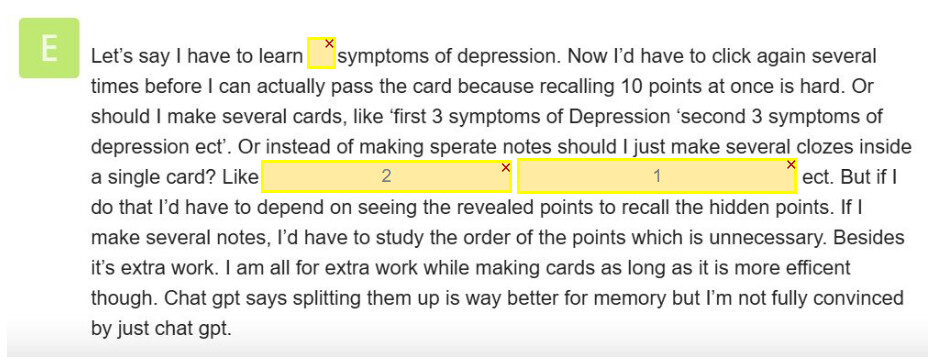
Let’s say I have to learn 10 symptoms of depression. Now I’d have to click again several times before I can actually pass the card because recalling 10 points at once is hard. Or should I make several cards, like ‘first 3 symptoms of Depression ‘second 3 symptoms of depression ect’. Or instead of making sperate notes should I just make several clozes inside a single card? Like {{c1:: first three symptoms}} {{c2:: second three symptoms}} ect. But if I do that I’d have to depend on seeing the revealed points to recall the hidden points. If I make several notes, I’d have to study the order of the points which is unnecessary. Besides it’s extra work. I am all for extra work while making cards as long as it is more efficent though. Chat gpt says splitting them up is way better for memory but I’m not fully convinced by just chat gpt.
Reddit post: Reddit - The heart of the internet.
Good question. It’s important to think carefully about any problem, whether it’s stronger or weaker. What if we have 100 or 1,000 rather than 10?
It seems so; it immediately becomes clear that we need to break it down into parts, but that’s what you’re suggesting.
There’s no problem with a single question: list the answers. But problems arise when answers can be given in any way, not from a list. The same problem applies to word translations, since some words have synonyms, and you have to write them all down (I don’t entirely agree here; synonyms can be learned by word frequency, and it’s actually helpful to remember the order in which the list appears). If we make separate cards, we’ll never know what answer we need to give. Then we have to enter that answer to check. But entering a single word isn’t difficult, and no one wants to enter sentences.
But in reality, that’s where we study: we see a question, what comes to mind, we write it down, and count it up until there are 10 points. When we can’t write down some points, we specifically memorize them. And note, no matter how much you want it to, your brain will remember things in its own order, but it will be the same each time, not different—that’s where our memory works; we can’t concentrate on multiple objects at once.
It’s the same with Anki: people often don’t create their entire course notes as flashcards, but only the parts they forget or don’t remember well.
This is one reason why someone else’s notes often don’t help someone who hasn’t studied. Of course, there are very detailed notes and very detailed flashcards, and they can help many. But then, make it simpler: if you have 10 (or 100) ready-made flashcards, then study one; once you’ve learned it, add another, and so on. However, people, those who study medicine, say that they hide all the cards at first, then look through them and from these thousands of cards they choose what they don’t remember and that’s all they learn.

You could use the add-on https://ankiweb.net/shared/info/675107747 to hide some facts you need to remember. They allow you to insert numbered hints, meaning that what you remember will be listed as 1, 2, and so on, while what you don’t remember can even be hinted using a word.
If you need to remember everything to answer an exam, it often happens that even one unanswered fact is not enough to pass. So, you should memorize everything on a flashcard, but what to hide and the order in which to show it is up to you.
This topic was automatically closed 90 days after the last reply. New replies are no longer allowed.