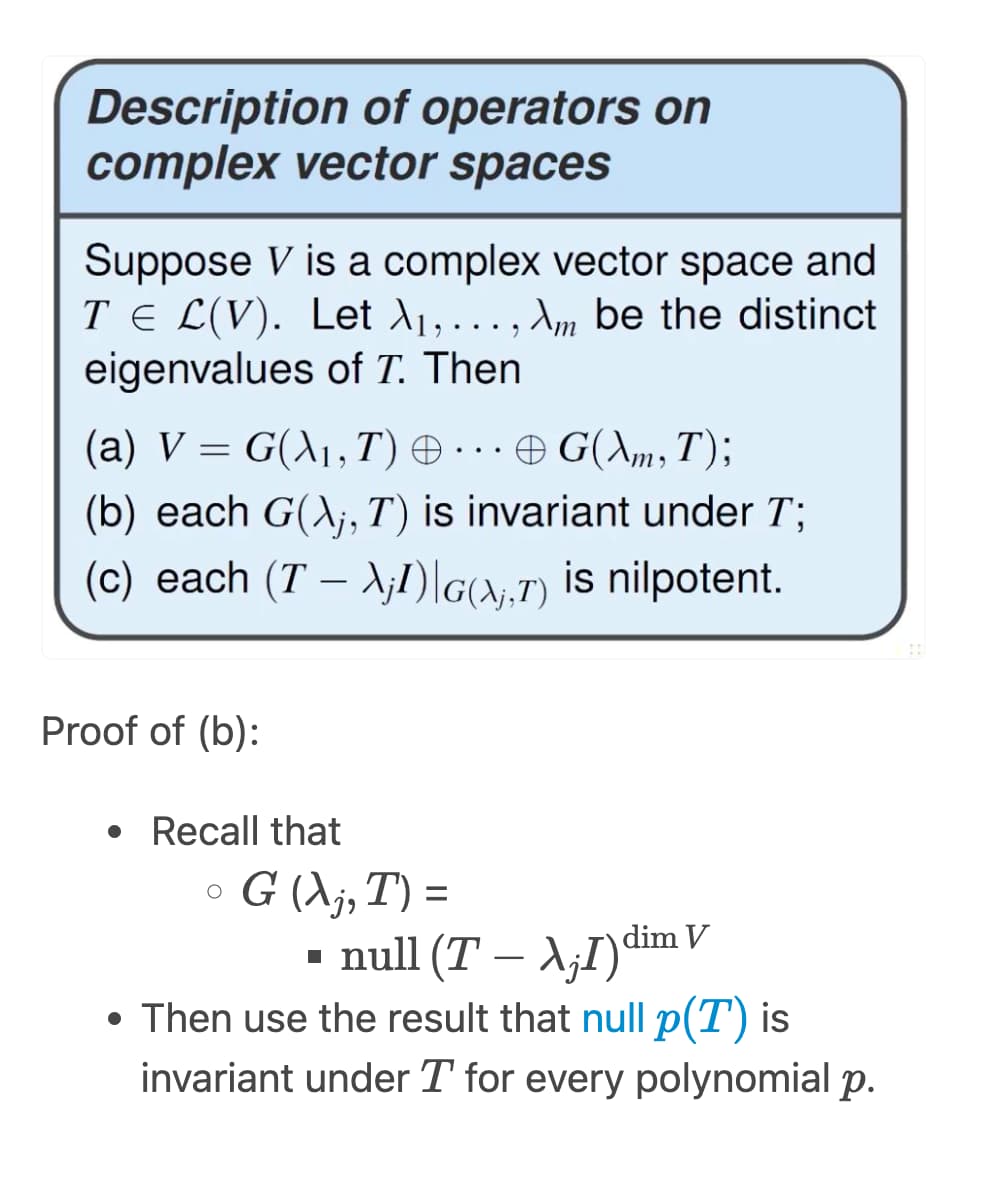
Proofs are a pretty clear case of when being able to hide information progressively is necessary for understanding.
Taking this fairly minimal card as an example, constructing a proof requires understanding a) the definition of a generalized eigenspace as the null space of a polynomial of a linear map, b) the fact that the null spaces of polynomials of linear maps are invariant under further applications of the linear map. The second piece of information is only insightful given the first.
For a more computational example, we can consider a proof like the following: each step is a computation step that depends upon the previous ones; randomly hiding any independent piece of the puzzle is utterly unhelpful as the context before and after are sufficient to disambiguate it entirely. Alternatively, hiding all and revealing one results in cards that are difficult to learn since they require doing chains of mathematical evaluation in your head without first knowing the overall structure of the reasoning. Progressive clozes mean that you must first learn part of the mathematical argument before reciting all of it.
Alot of my cards rely on nested. I use it alot to break down spelling of complex drugs while staying in the context of the card. It is usually very convient to do it in general cloze notetypes instead of the cloze notetype where you have to copy paste the text multiple times so the cloze don’t become nested.
The ai overview stated that there would be increased computation time if the amount of nested clozes increases, where would this increase occur when using anki and how severe may it be? If it is just that it would be the same speed as older versions and the new update just boasts faster speeds due to limiting it then that would be fine