Since this thread got going, I will throw in my two bits. I will try to be helpful, but I might fail at being diplomatic.
I don’t really see a good use case for this add-on.
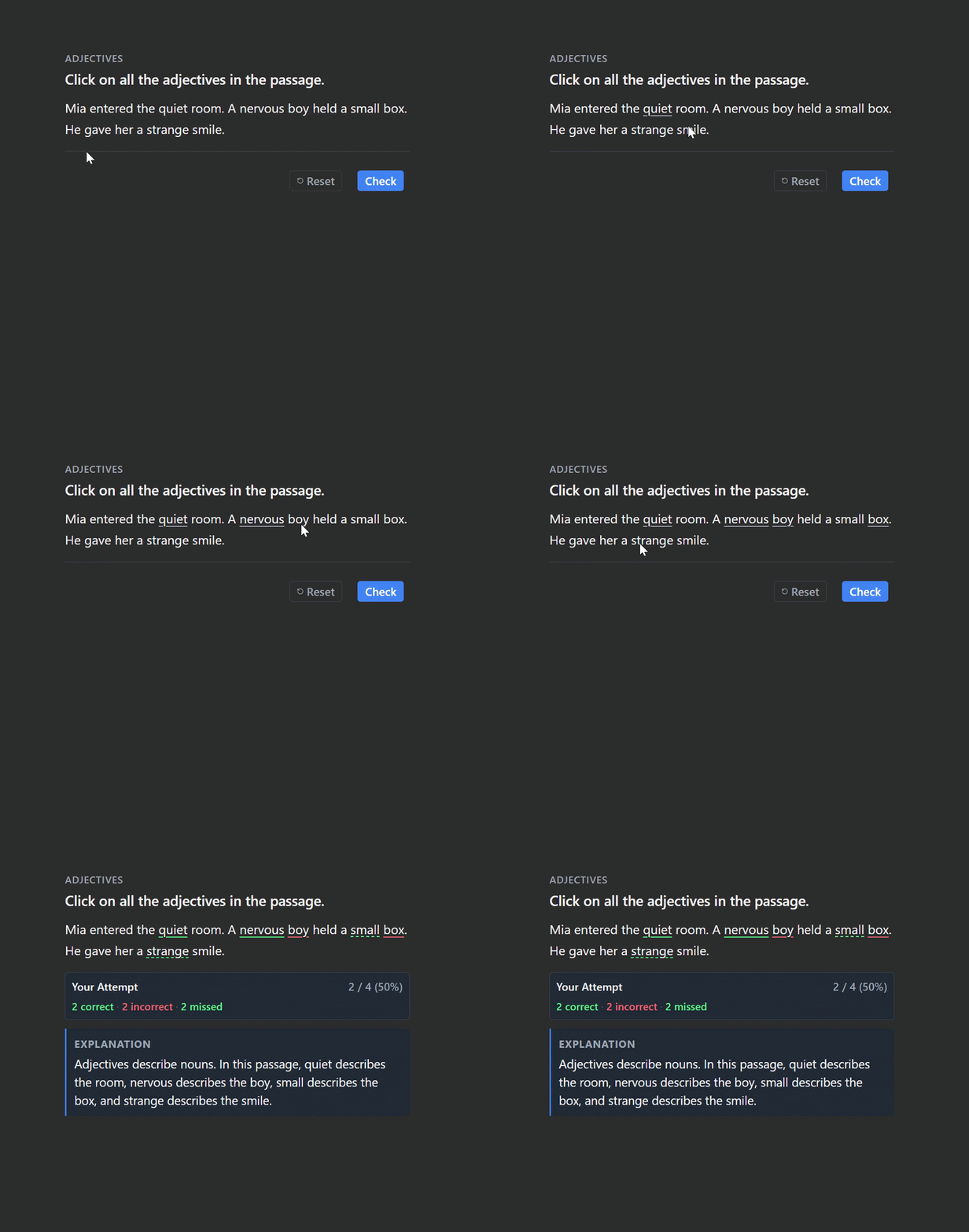
In my opinion, the example you gave could be useful for someone who has trouble with the concept of adjectives. But is that really what you are after?
If I was forced to impose this kind of exercise on students, I would first use more natural, less contrived speech. E.g “When Mia entered the quiet room, a nervous boy with a small box gave her a strange smile”. Only then would I use it to practice identifying the main action (gives), the main subject (a nervous boy), the main object (a weird smile) and so on. I might also use it for reading comprehension (Who entered the room? What did the boy give?). More generally: Who does what, when, where and how?
I also wouldn’t use this add-on to generate Anki cards, since I don’t think this kind of exercise benefits from spaced repetition in particular or repetition in general.
For practicing grammar, I mostly use very specialized cards. E.g. “When Mia entered the room, a nervous boy {{c1::gave::(to give)}} her a strange smile” to practice time concordance or the past tense.
The other exercise I do, which is more one-size-fits-all but not meant for spaced repetitions, is to copy a sentence from memory. I might catch myself making mistakes (“the nervous boy gived the weird smiles”), taking shortcuts (“a boy gave a smile”) or substituting other words (“the nervous child gave a weird laugh”). I find this latter exercise quite helpful but much more time intensive.
Of course, I might be wrong about everything, so take what I wrote with a grain of salt. In any case, designing an add-on to practice grammar is quite an undertaking, so hats off to you.